
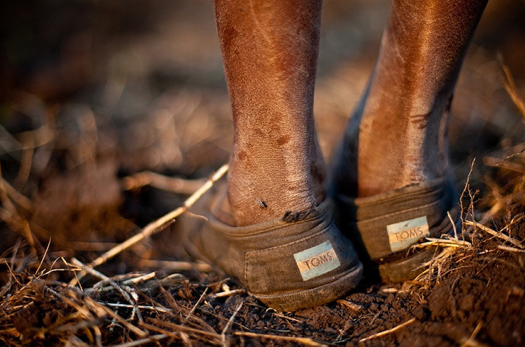
Why I Hate TOMS Shoes

By Topher Hendricks | November 2nd, 2011 | Buzz Blog, News & Views

Image Courtesy of Flickr Creative Commons

You know what really grinds my gears? TOMS shoes.

OK, I get it. They’re stylish. Even I admit to loving their minimalistic, yet classic, design. In fact, thanks to rewards from my credit card, I’ll even own a pair soon. But I’m tearing off all the damned logos from them, and I’ll tell you why:

People keep forgetting that TOMS is a for-profit company and not a charity. The fact is that similar designer alpargatas sell for around $20 or $25 in boutique shops (I saw them all over the place in Beverly Hills when I lived there earlier this year). With the pair I got (for free) running at $54, TOMS has magically made “buy one for the price of two” a reality. They aren’t taking a cut by donating a pair of shoes; they’re actually making a profit for every pair they donate.

The ‘One for One’ campaign – the premise that for every purchased pair of shoes, TOMS will donate one to “a child in need” – is simply one of the most clever marketing tools of all time. And here’s why: Positioning your company as a charity rather than a profit-making private entity gets you the added benefit that Americans are so massively glad to justify their consumerism as something that it’s not. You’ll see this in the form of student organizations at college campuses all across the United States that urge students to buy TOMS in bulk.

And they do. And TOMS reaps those profits thanks to a marketing campaign that is literally costing them nothing, because we are so eager to write off our consumerism as being beneficial for the less fortunate.

I’ve heard people say that at least TOMS’ business plan is better than not donating anything. But are they so sure? Donating the shoes for free to an underprivileged community is an incredibly, incredibly short term solution (the flimsy design of TOMS shoes in particular only shortens it more). By giving away shoes, it completely undercuts whatever market there might have been in a foreign community, making the communities more reliant on donations. Sorry for sounding a bit like a right-wing nut job there, but I have a better idea for TOMS: Help those local markets by finding a way to allow local craftsmen and merchants to manufacture and sell the shoes, building up the local economy for the future (which also makes them more environmentally stable by cutting down on shipping, and sourcing local materials).

There’s also a lot of classism going on here, with the rich Americans essentially throwing around their money to ‘help’ others; we should be working with these people to build up their communities, not just throwing short-shelf-life donations at them. “Teach a man to fish,” that whole thing.

I could maybe forgive all of this if Blake Mycoskie wasn’t such a massive douche. He refers to himself in interviews as the CEO of a “movement.” No. You’re the CEO of a massively profitable fashion company. You live in Los Angeles. You own a yacht. Maybe if you got off your high horse, you could see that the way you post pictures of underprivileged children in your brochures and stores is a means to exploit American consumers to feel bad and buy your shoes (have you ever heard the term ‘poverty tourism’, Blakey boy?). But I’m sure you already knew that, because it’s all part of what I would consider to be the greatest (and most sadistic) marketing campaign the world has ever known.

So I might wear that pair of shoes when they get here (did I mention I didn’t pay for them?), but I will tear that smarmy little blue and white logo off the back so no one confuses me for someone who thought he was saving the world. I can’t take another day of a peer trying to sell me on the idea that TOMS is a charity. At the risk of sounding like some anti-establishment college student cardboard-cutout, I know better, Mycoskie, and I’m not buying your bullshit. You’re not a savior. You’re not a revolution. You’re a shoemaker. Stick with that. I hope your charade unravels as quickly as my pair of TOMS will.

    Buzzsaw Also Recommends:
  • A Different Perspective on TOMS Shoes by Rebecca Coffman (November 3, 2011)
  • How Moral Are Your Fibers? by Brittany Romano (February 29, 2012)
  • Lu(RED) by Colo(RED) Activism by Abby Sophir (December 8, 2010)
  • If The Shoe Fits & It’s Not Hideous by Sarah Craig (December 6, 2008)
  • A ‘Good Fortune’ Teller: Filmmaker Jeremy Levine by Kaley Belval (February 29, 2012)
  • 32 Comments on “Why I Hate TOMS Shoes”

    1. brittnee

      You forgot to mention that Tom’s shoe factories are located in Ethiopia and 2 other 3rd world countries… so essentially the employees get shoes for their family members.

    2. Ger

      To sum this up, you’re mad because they donate shoes AND make a profit? Oh No! What a horrible organization, enjoy your TOMS shoes by the way.

    3. Merk

      I’m not sure what the problem is. Common sense dictates everything you said above, none of it is a secret or something to flip out about. Yes, it’s brilliant marketing but its not a reason to rip the logo off an not support the organization. I just feel that the option to purchase shoes from a company that will actually donate some shoes elsewhere is cool. Regardless of the price.

      I don’t agree or disagree with Tom’s.
      No I do not and will never own a pair.

      • Julian

        You are forgeting that it destroys local industry. And that the shoes suck.. Their not really helping anybody.

    4. Topher

      It seems like people are apparently grazing over the whole paragraph about how simply donating shoes is a short-term solution that helps no one, because it undercuts the markets of the poor countries, and essentially leaves them more impoverished. And as I say above, “I could maybe forgive all of this is Blake Mycoskie wasn’t such a douche”; that’s alright if you folks don’t mind exploiting the problems of other people for your own gain, but that just morally doesn’t sit right with me. I’m not mad because they donate and make a profit; I wish more companies would (this is one reason I love Wegman’s so much). I’m mad because of the manner in which they do it, the way they falsely represent themselves, the reality of the negative effect those donations can have, and the way they emotionally exploit consumers and the impoverished. If you really want to donate shoes, then do it yourself; you don’t need some asshole CEO to do it for you (I just donated a whole trunkload of clothes and footwear to the local shelter).

      And thanks Brittnee, I had heard about that, but I wasn’t sure about the conditions of the factories or if they treat their workers with respect or a decent wage. If they do, then I’m thrilled, and that’s a big plus to them. But for now, I’ll assume they don’t, since they don’t tout that like they do the rest of their ‘charity’ work. So if you can find any reliable info about their factories, do let me know!

      • Kenny

        I studied TOMS for my final in BA 205 last spring and the only reason they are a for-profit company is so they can give more shoes away. They need to make money so then they can expand to be able to produce more shoes. If they were a non-profit they would be subject to investors’ dollars. Mycoskie felt that no matter how good the investors’ intentions were at the time, if times got hard they would bail and leave TOMS unfunded and in the dust. Mycoskie didn’t want that to happen so he decided to make TOMS a for-profit organization. This article was written without acknowledging that at all. Honestly I think you are just unaware, but if you want to blow up about something, you should probably do his homework first.

        This comes right from my term paper talking about fair working conditions:
        TOMS currently manufactures its products in Argentina, China, and Ethiopia. TOMS employs, “fair trade practices, although there are currently no official fair trade standards for footwear manufacturing.” TOMS requires its factories to “operate under sound labor conditions” and strictly follow International Labor Standards. All factories must sign a code of conduct. This code is enforced by routine visits from both TOMS staff and external auditing companies. These check-ups ensure that TOMS “factories provide a clean, safe place to work, fair wages and treatment, and never employ underage labor.”

        “TOMS Manufacturing Practices.” TOMS. Web. 10 May 2011. .

        Blake Mycoskie was rich before TOMS and owned all that stuff before the company. He was an entrepreneur, not some random guy with an idea about shoes. He already had money then decided to make TOMS after a trip to Argentina. And even if Mycoskie is a major douche, at least he is a douche that is giving shoes to people that don’t have any. You’re just a douche.

        • Topher

          Thanks for the informed response Kenny. Please excuse me if I’m skeptical about this justification for making them for-profit; I feel that if he really truly wanted more money to sit in the TOMS reserves for when times got tough, he probably wouldn’t take a multi-million dollar salary from those reserves (especially if he was already rich beforehand).

          I AM actually happy to hear about the factories. I’m dismayed the info comes from the TOMS website, and that it follows “International Labor Standards” (which are actually rather shite), but it points in the right direction. Assuming they are making a fair wage, that is the way to support these underdeveloped communities. This is the best thing I’ve heard about TOMS, and I hope that it’s true, because it provides not just some shoes that’ll last for a couple weeks, but jobs that will last for years: providing a hell of a lot of pairs of shoes, shelter, meals, etc. I’m glad to ‘overpay’ (at least by American capitalist factory-slave-manufactured standards) for items if it means it’s going to someone making a living wage. It’s far, far more important that TOMS would have factories like this than just handing out some flimsy shoes. I will gladly give them credit for this, and it gives me a new perspective on them. THIS is a charity plan that makes sense.

          You said, Mycoskie is a douche giving shoes to people that don’t have any. No, his CUSTOMERS are the ones giving the shoes away, remember? We’re paying for them, not him. I will openly admit I am a douche, but I am ALSO giving away shoes to people that don’t have any. Except I don’t make millions doing it, and I’m not helping him make millions doing it. I’m just not comfortable with salaried ‘altruism’. If the end game is a simple donation, the point I’m making is there is no need for a middleman to be taking money out and putting it in his personal piggy bank. The real benefit is the factories and a living wage, something an average citizen does not have the capital to do. The real effect that a company as large as TOMS can have is in shoring up the economies of a foreign nation for real, long-term solutions, not simple one-time short-term solutions. Give them shoes for a lifetime with a job, not shoes for a few weeks.

          This will be my last response to posts, as I’ve made my point, and I’m too stubborn to have my mind changed. DONATIONS: too short-term a way of thinking. JOBS: yes. MYCOSKIE: still a douche. ME: also a douche (but at least I admit it).

          • Topher

            (It wouldn’t let me continue typing the rest of my response in that box):

            The fact is, nothing is stopping other people from making donations. We don’t need Blake. Why don’t you go out and donate some clothes and shoes today? Why doesn’t everyone here? And why stop at one pair? Go into your closet now, dig out the three pairs you wear the least and pass them on to someone who needs them. There’s no reason not to. The people with power and capital should build the businesses abroad. Leave the donations to us, since we ALL have that ability to do it ourselves. NOW GO OUT AND DO IT.

            • Kenny

              Yeah I got the info from their website, but where else was I going to get it from? Another site that would have copied the same info? It is hard to find information about private companies because they are not required to supply it to the public. So yeah ya got me there.

              Honestly it doesn’t make a difference to me if people like TOMS or not, so go on hating. I honestly don’t feel like you’re bringing reasonable arguments to the table. So you want me to get my three pairs of shoes I wear the least and send them out to Africa? Okay that’s going to be really cost effective for me. I don’t get my jollies out of sending three pairs of crappy shoes to Africa. I think what Mycoskie was trying to do was make helping easier for the consumer and yes I agree, that is a great marketing tool that will bring in profits. And why shouldn’t it be? Because of his organization people in poverty across the world receive shoes. What a crime right?

              If you really wanted to argue a REAL point, how about talking about how systematic foreign aid hurts local economies. It creates dependencies on the aid rather than promoting self-reliance. Some people have forgone buying shoes and spend what little money they have elsewhere. They did this explicitly because they assumed they would be receiving donated shoes. Once you give, some people will be dependent on it.

              And this would be an acceptable counter argument, not just the fact that Mycoskie is a big douche CEO. I don’t agree with the whole “systematic foreign aid hurts local economies” thing, or at least I don’t feel that is what TOMS is trying to do but may be a problem with their system, but at least it is something to actually complain about.

              And I know you know, but you replied twice after you said you would leave no more than your first original reply. Thanks for the second one, a double-helping of mega douche was much appreciated. Later.

            • Chris

              Great article, Topher. I think your comment above is the most salient, and actually might represent a stronger argument than the original article. Why pay for an extra pair of shoes, some of which disappears as profit, when instead you could donate your own clothing? (Or if you wish to spend the money, make a donation to improve access to water or healthcare.)

              The TOMS “Giving Report” offers a quotation that would be hilarious were it not terrifying. “Shoes are a status symbol [in Ethiopia]. Children dream of having their first pair.” I think this gels nicely with the point you’re making about exploiting Western “sympathies.” Can’t we at least tug at the appropriate heart strings? TOMS is shorthand for a rudely conceived sort of goodwill – yet at the same time it exploits a community (America) that thrives on the exploitation of others. There’s something tragically poetic (and douchey) in that.

              I’m always fond of Jesus references in journalism, but even if these factories are 100% positive (and you have good reason to doubt them as you noted above), I wonder how much TOMS teaches its employees to fish versus how much it allows them to fish from the corporation’s pond. And how much of a difference does this make?

            • No

              1. Those shoes you donated made a profit for someone at some point. Nike? Millions. Any shoe you donated? Probably making millions.
              2. Blake sold his house for the “Yacht”
              3. You are a douche and you never know if Blake would admit to being one too

    5. Becky

      I have no problems with a company making a profit and giving to charities. Have you ever looked at the pink ribbon campaign? It’s a very profitable company posing as a charity. I’d much rather support TOMS.

      You should look up a charity called Shoes for Africa, then tell us how insignificant that single pair of shoes is to someone who doesn’t have them. Just wearing a pair of shoes can cut down on disease infection in ways you haven’t thought of.

      I’m proud to wear TOMS and happy they are donating them.

    6. Topher

      Someone just pointed out this campaign by Levi’s to me as a counterpoint to TOM’s methods:

      http://www.nytimes.com/2011/11/02/science/earth/levi-strauss-tries-to-minimize-water-use.html?_r=2&scp=1&sq=Levi&st=cse

      Levi’s is teaching farmers in underdeveloped countries how to grow their crops using less water so that they’re better able to have abundant crops and support themselves economically in the future on their own. Instead of just giving them some crops now if there’s a drought, they’ve shown them how to get through that, so that they can sustain themselves. Not sure how well it’s working out yet, but this is the sort of for-profit charity work I can (in theory) get on board with. It’d be great if everyone had a pair of shoes to protect them diseases; it’d be a lot better if they were able to make those shoes themselves when TOMS isn’t trendy anymore.

    7. John

      We figured this out a while back (it wasn’t an original thought of mine – I think there was a similar article, or maybe message board post that was essentially what you’re saying), and we completely agree. But my friend and I tried explaining that to my her 16 year old daughter, and she still can’t quite understand.

    8. Megan

      Lol. If this is suppose to make TOMS look bad, fail.
      You definitely pay for 2 pairs of shoes for the price of one, the consumer is donating (granted there’s still profit of course, but you have to profit to pay employees)
      TOMS = expensive sort of flimsy shoes, but a company has to be profitable to pay for employees and to expand. Now they have sunglasses and shirts. It’s not like any TOMS product is that much more money than any other shoe in Foot Locker is something. Yea, you can buy the same quality shoe for $25 (half the price), so you buy 1 pair which goes to you, rather than paying the price of 2 shoes where you get 1 and 1 is given to someone in need.
      Super run on sentence, but that made sense right?

      I bought a sh*tty pair of shoes from forever 21 for $20 which wore out as quickly as TOMS, not nearly as comfortable and no one benefited from my purchase.
      I don’t get why it’s wrong to be for-profit AND donate product. Most companies are just straight for-profit companies.
      BOOM point made.

      • Chris

        Actually, while “a company has to be profitable to pay for employees and to expand,” profit is not needed to pay employees. Profit is whatever a company makes above and beyond the expenses of bringing an item to market, which includes materials, shipping, manufacturing, and paying employees. You can sit at zero profit indefinitely and run a fine company – you just won’t grow.

        For-profit companies are allowed to distribute surplus revenue (profit) to employees and shareholders. Non-profits must reinvest profit (anything above and beyond the cost of bringing an item to market) to grow or expand.

    9. Adam Polaski

      Rebecca Coffman responds to this post and provides a counter-point here: http://www.buzzsawmag.org/2011/11/03/a-different-perspective-on-toms-shoes/

    10. Kelly

      I have an issue with one of your arguments, Topher. While you claim that giving away shoes is a short term solution that leaves underprivileged communities dependent on donations, you urge people to dig through their closets and send their own shoes away. That’s still a donation. Donating your own shoes will have the same consequences as Tom’s giving away new shoes.

    11. Meredith

      There are not enough volunteers with enough time and funding to ever go around solving all the world’s problems from the ground up (teaching them to fish). If that is your theory, then it seems as if you would be against all charity (passing out food, clothing, etc. to those in need). As in, why provide temporary shelter and a meal to the homeless, when we can teach them to work and budget their money??? My belief is that these need not be mutually exclusive. You can help them while teaching them to help themselves. What you propose is a grand philosophical idea, but not at all realistic the whole world over.

      You also wondered why individuals don’t just go buy shoes for others and donate them personally. That’s another grand idea… if only we were all so generous! Most people would never do that, sad to say. All I know is that this “One for One” IS putting shoes on the feet of some people who may otherwise go without. So long as the company is working ethically (and they do have fair labor practices), why complain about them? They never claimed to be a non-profit, and unlike the majority of for-profits, at least they are doing SOMETHING. And even if their CEO owns fancy things, who cares? Should everyone donating to charity live in poverty? He built a successful business, he can live however he wants. Good for him.

      Sheesh, man! Complain about someone doing evil in the world. Expose some corruption. Maybe challenge those that are doing nothing at all to make the world a better place. I think that would be time more wisely invested.

    12. uggs

      I agree with you, but please look at uggs.

    13. Paula

      Technically I think you DID pay for the shoes in a way, paid for by using the points that you’ve gotten from your own consumerism…

      but still a great article, thanks for articulating this!

    14. LSC

      has anyone considered what these children do with the shoes once they grow out of them? I can remember when I was younger i grew out of shoes every 10 months and saw no end until my late teens. Also, has anyone taken the thoughts of those receiving the shoes? Im highly in support of the act of giving but if I was in their FEET, a 20 dollar pair of shoes would not be in the best interest of mine or my families

    15. Frank

      Geez, people. When they’re made in Ethiopia, it’s a form of establishing a sustainable economy for people who have no or little economic standards. If TOMS makes a decent income while providing shoes to those in need, so be it. What are we to say, ” TOMS, you can only have your shoes made in Ethiopia if you don’t help Ethiopians, and that you receive no compensation in return?” Society these days. Keep jumping down throats like there is no reason for anyone to jump down yours. Topher Hendricks, nice attempt at pretending that you are in any position to voice any opinion at all. Fail.

    16. Becky

      I don’t get how everyone is missing the big picture. Yeah it’s great that when you buy Toms and give a pair but it is only a short term solution of a long time problem. When you donate these shoes it’s giving a hand out to a 3rd world country ( like Africa). This makes that country dependent on our country (America). This can also hurt the local economy. As stated above, this can harm vendors in the country, especially if their chosen profession happened to be shoe making.

      Instead of just giving these shoes out, Companies like TOMS should help out these third world countries by developing long term plans for economic development. They should create ways for the people of these 3rd world countries to benefit more than just receiving a pair of shoes that can wear out very easily. (Along with this consider how fast Americans wear these shoes out and compare it to how fast people in 3rd world countries would wear them out. People in 3rd world have longer distances to travel and potentially harsher climates. They also don’t have the luxury of sidewalks.)

      The solution to this is economic growth. By creating a plan to allow people of the countries to benefit by creating new jobs and to reap the profits of the shoes. TOMS should not import the shoes but should use materials from the 3rd world countries to make the shoes. This would create numerous jobs considering you would need raw materials such as cotton, rubber and even dyes.

      The creation of these jobs add to economic growth. If these 3rd world country workers get jobs they make money. When they make money they spend the money, when they spend the money it add to the economic growth creating a demand for other products, thus creating more jobs. These workers can then buy their own shoes and would cause demand for those and etc. Its an amazing economic cycle!

      But unfortunately TOMS does not do this and instead hinders these countries creating a sort of crutch. I’m not saying that TOMS is doing a bad thing. I just think they are going about helping these countries the wrong way.

      Also TOMS is a for profit organization. Meaning they make money. A non for profit organization makes enough money to “pay” their workers and to sustain the company but does not make any additional money. TOMS does not to this. TOMS makes money off of every pair you buy and every pair you give away. Also people are saying that they make money to donate more shoes. How can this be when in addition to the pair you buy, you also “buy” the donated pair? But then again I do not know if they continue to give once the initial pair is bought. This would make sense. But again I DO NOT KNOW if they do this.

      I also have a problem with TOMS marketing themselves as a charitable business when they are for profit. It also seems as though people have presented this economic growth plan to Blake but he has not implemented this into his “movement”. It would make more sense if he didn’t just hand out the shoes but also used the “charitable funds” for possibly provide micro loans to the families of the children receiving the shoes. I think TOMS’ CEO Blake has good intentions but his good intentions might be overall harming the local economy when he could help build it up. It just doesn’t seem like a very charitable business if you buy the shoes they are “donating”.

      Like I said TOMS may have good short term intentions but may be harming these countries in the long term.

    17. Ben

      Seriously? Regardless of what you think about TOMS shoes, when was the last time any of you writing these comments actually did anything yourself? You’re criticizing an organization for “not being helpful” to local economies but when was the last time you actually did something to help these local industries? If you’re going to criticize TOMS, then shut up and do something. At least they’re providing fair jobs in Ethiopia and China, that’s more than you’ve done.

      And for those who are asking, yes, I am doing something. I live in a 2nd world country and work with students from the Central Asia, Eastern Europe, etc. (Former Soviet Union) on how to become proficient in English as well as how to design business plans and strategies so that they can bring economic development back to their home countries.

      • Dave

        Pics or it didn’t happen

    18. George

      You’re right, let’s all buy Nikes!

    19. Katie

      I think some people are missing the bigger picture. Sure TOMS is doing some good but they can definitely do more. TOMS is a “I will help only if I get something in return” type of thing. Well at least you did something right? You can walk away feeling good about yourself. Who really cares about the kid that the shoes go to? They might die of starvation but at least they won’t die of some kind of disease and they’ll look so fashionable.

    20. Jess

      I agree with you completely, but the only thing I wanted to point out is that the “smarmy” blue and white logo is actually the argentinean flag. As an argentinean myself, I can tell you that you can go to Argentina right now and you can find those same shoes (authentic ones) and they will be SO much cheaper, maybe even for less than 5 USD. It’s ridiculous how much of a marketing ploy all of this is, and I am completely ashamed that I have friends who own them, much less that the majority of them (who have known me for my whole life and know I’m from argentina) wear those shoes without even realizing what they are REALLY about or even that the damn logo is more than just blue and white. Sorry, I know that is a bit off topic but it just makes me itch haha. Anyway, another thing that pisses me off, is that most of the people that are getting those shoes in places especially in Argentina are people who are actually bad people and are ruining the country itself. I’m sure there are good people in the mix of the crowd, but americans don’t know enough about world politics. This isn’t a charity, but if it was, it may not be a good one is all I’m trying to say. A lot (key word a lot, not all) of the people in argentina that need shoes are the ones that are bringing the country down. It’s as if some country came here and gave all of the illegal immigrants money or something (not that I am against illegal immigrants, I’m actually close with many). Anyway, I’m done… because I could go on and on at how angry this all makes me and I’m not even making much sense :)

    21. Amity

      i would just like to point out (and this may have already been done, I didn’t read all the comments) but I searched the website high and low and did not find the word CHARITY anywhere. Only company, and movement. They never were and never clammed to be a charity. Simply a company trying to make a difference. If you set up a completely full functioning non-profit organizations that does everything you seems to think Toms fails to do let me know and I’ll sign right up!

    22. Anne

      So, you are going to wear the shoes without the logo….. I’m pretty sure people will recognize them. Just saying. Also, I think it may be wise to first give people shoes before we teach them business practices. I don’t know about you but I wouldn’t want to start a business if I didn’t have shoes first. Prioritize.

    23. KC

      If your friends are trying to tell you TOMS is a charity, they’re just uninformed. This guy’s not pretending to be a charity. He also admits on his website that the price the customer pays covers that of the donated pair and the delivery costs. He’s doing what he said he’d do, which is help children in need get shoes. No it’s not a permanent solution. But if the kids can’t get to school barefoot, or they’re permanently crippled by elephantiasis, that’s not really a step in the right direction either. I used to feel the same way because I hated when people got all self-righteous about their “self-less” purchase, but that’s no reason to hate on the founder. I’m doing a research project about TOMS as we speak, and comparing it to other cause-related marketing schemes, it seems to be the most entrenched in the actual cause it supports. There are always criticisms for people who are trying to make a difference because they can’t fix the problem immediately. But the world isn’t gonna change over night.

    Leave a Reply